I always start with good intentions when I’m reading: “This time, I’ll take careful notes as I go along, rather than imagining I’ll somehow remember the important bits.” In reality, I’m trying to balance a cup of tea and book, so can’t possibly manage my writing materials, too. Happily, AudioPen has solved at least one of my problems.
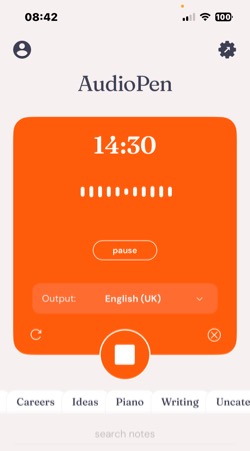
AudioPen is an AI-based app that turns your voice notes into structured, edited text. Any repetitions or ums and ahhs are automatically eliminated, and it adds all the punctuation. That two-minute ramble is turned into a perfectly respectable paragraph. You can then organise your transcribed notes with folders and tags. For instance, you might have a folder for a specific research project, then a tag for each related book or article you read. It’s not quite hands-free, but using AudioPen can be less disruptive than physically writing. There are well-known benefits to using pen and paper, but recording and transcribing a voice note is better than not making any notes at all.
An AudioPen Example
I’ve created a deliberately exaggerated example so you can see what AudioPen does. Here’s the transcription of a rambling note about Middlemarch by George Eliot (I don’t speak like this, honestly):
In Middlemarch, well, there’s a doctor who’s like an important figure. He does typical doctor stuff. Diagnoses things. He’s also got tons of other stuff going on. Relationships. There’s this thing with his wife, Rosamond. She’s pretty and proper and this causes like tension. Then there’s this other guy, Lydgate, who’s also a doctor and they’re kind of rivals or I guess you’d say, but then again they’re not because they’re both doctors so they have to be professional. So he’s both important and messy like life. He’s trying to figure things out just like we all are but he’s kind of got to pretend that he knows what’s going on.
You’d probably know what you meant, but it’s not going to help you get started with your writing.
Here’s the cleaned-up version from AudioPen:
Middlemarch Struggles
In Middlemarch, a prominent physician grapples with multifaceted challenges, both personal and professional. As a doctor, he is responsible for diagnosing various ailments and maintaining a poised demeanour.
However, his personal life is rather tumultuous. His wife, Rosamond, is an attractive and well-mannered woman whose presence generates underlying tension. Furthermore, the protagonist faces competition from another physician, Lydgate. Although they share a professional rivalry, they are compelled to maintain decorum due to their occupation.
Ultimately, the central character embodies the complexity of life as he endeavours to navigate his intricate circumstances while maintaining an air of confidence.
This is much clearer! There are proper sentences and it’s easier to read. The tone is quite dry and it’s not how I’d normally write, but this is a more useful note. Crucially, AudioPen hasn’t changed my meaning. When I tried this exercise with ChatGPT, it added extra details, such as characters’ first names (one of which it got wrong).
Which brings me onto an important caveat about using AI-based tools in academic research.
A Note of AI Caution 🤖
Thanks to its AI features, AudioPen is an incredibly powerful tool. You can ask it to significantly rewrite your note, or even write in the style of a specific author, like Judith Butler. Here’s that Middlemarch example again, this time Butler style:
Physician’s Entwined Existence
Within the narrative of Middlemarch, a physician emerges as a central figure, engaging in customary medical practices and diagnosis. Simultaneously, his life is entangled with various relational complexities. His spouse, Rosamond, embodies beauty and propriety, generating underlying tension.
Another character occupying the medical sphere is Lydgate, fostering an ambivalent relationship of rivalry and professionalism with our protagonist. Thus, the doctor navigates both significance and disarray, mirroring the intricacies of life as he endeavours to decipher the labyrinthine world around him whilst maintaining an air of certainty.
As before, AudioPen hasn’t substantially changed the meaning, but it has produced a very distinctive style. If you’re using AudioPen for academic work, it’s important to check your institution’s policy on AI use. Typically, this type of rewriting is prohibited.
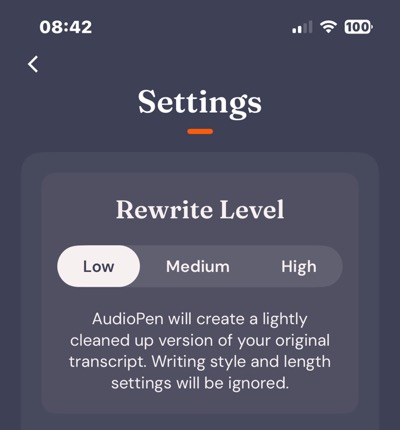
Personally, I use the Low setting, which operates a light touch of removing repetitions and adding punctuation. That way, I know AudioPen has recorded my original thought and not added any extra ideas. And it still sounds like me.
Conclusion
Used wisely, tools like AudioPen can streamline your research workflow. I’ve linked AudioPen to Obsidian, my favourite note-taking tool. Wherever I’m reading, all my tidied notes are delivered to my desktop where I can access them for my current project.
The free version of AudioPen is limited to 3-minute recordings, which is probably enough to capture a thought. With the paid version, you can record up to 15 minutes and even upload existing voice notes. You also get access to many more features, such as the ability to create custom vocabularies and super summaries of multiple notes. This costs $99pa or $159 for two years. AudioPen is available as Android and iPhone apps and also works on any web-enabled device.1
AudioPen isn’t just for reading, either. You could use it to record field notes or even transcribe interviews - you’ll get the original unedited transcription for comparison. But, as with any AI tool, you need to make sure you know what it’s doing. And, of course, you shouldn’t use apps like AudioPen for holding sensitive data. For a privacy-first (and cheaper) alternative, take a look at my post on MacWhisper.
For reading, though, AudioPen makes it easier to hold a book and a cup of tea.
👉 We discuss AudioPen and similar tools in my workshop Accelerate Your Research with AI.
I’m not affiliated in any way with AudioPen, I’m just an enthusiastic user. ↩︎