A few years ago, it would’ve seemed ridiculous to pay for a search engine. Google was fast, comprehensive, and convenient. But as Cory Doctorow points out in his book Enshittification, Google has become, well, enshittified. Now it mainly delivers AI-generated slop and irrelevant ads. Fortunately, Doctorow also recommends an alternative: Kagi.
Kagi (pronounced KAH-ghee) is a paid ad-free search engine. It’s actually a metasearch engine, as it aggregates results from other established search engines, such as Google and Yandex. So, you get the benefit of the Google index, without all the distortions. Since moving to Kagi, I’ve discovered so many useful websites that had previously been buried on page 23 of the results.
As with Google, you can filter results by videos, images, news and so on. Kagi also offers Lenses, allowing you to restrict the search to academic sources, forums, PDFs, or even Kagi’s own documentation. There’s even a Small Web lens, which favours non-commercial domains and topics. If you search for loo paper, you’re more likely to get an informative post on the history of sanitary products, rather than an offer to “Buy it used on eBay!”.
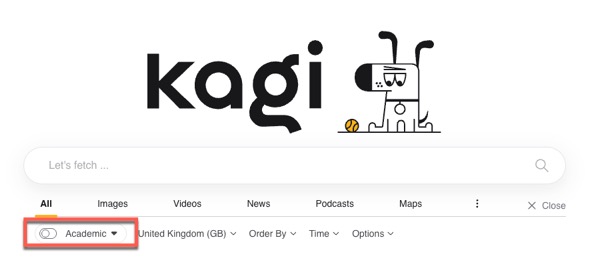
Kagi’s business model is delightfully clear: “you pay, we provide the service”. They don’t monetise your data or track your activity, beyond what’s necessary for the search function. The pricing is also both reasonable and straightforward. I currently pay $5 per month, which gives me 300 web searches and 300 chatbot interactions (more on that in a moment). If I don’t use Kagi for a whole month for whatever reason, they don’t charge me. Remarkable. For $10 per month, you get unlimited searches. As the quality is much higher, I find I’m using Kagi less than Google: it yields what I need in just one shot.
As if that weren’t enough, Kagi Assistant is a privacy-focused chatbot, offering a range of AI models. Through one interface, you can flick between Claude, ChatGPT, DeepSeek, and many more. The cheapskate subscription of $5 gives you access to only the most basic models, but they’re sufficient for general queries.
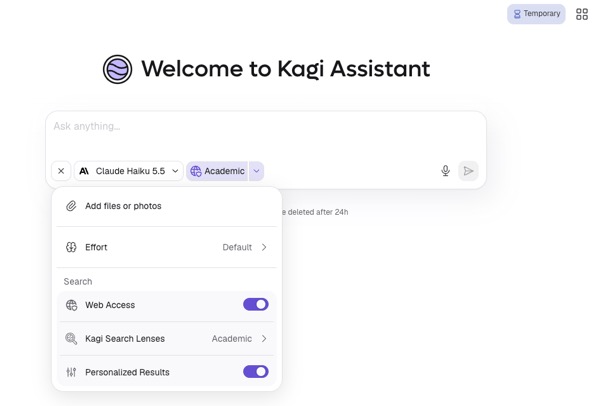
Like the search engine, you get many options with Kagi Assistant. You can enable or disable web search, and also restrict the type of web content you want it to include, such as only academic sources. Your threads (or conversations) can be temporary by default, so they’re deleted after 24 hours (or a time period of your choosing). For academic research, it’s a good idea to keep an audit trail of exactly how you’ve used AI. But temporary threads are useful for more personal searches, where you don’t want a record of that existential crisis. The advantage of using Kagi rather than Claude or ChatGPT directly is that Kagi doesn’t send any identifying data to those third parties.
Through Kagi, I’m getting high-quality web search and a decent chatbot, all for $5 per month. There’s a free trial, too. If I need a more powerful or specialist model, I use Jan and a pay-as-you-go subscription. That way, I’m not paying a monthly subscription for something I’m using only occasionally.
It’s a long time since I’ve been excited by a search engine, but Kagi is making the internet usable again.
We discuss Jan and other alternatives in my workshop Using AI Responsibly in Your Research and Writing.