After launching myself into piano playing with characteristic zeal, I suffered a hiatus for almost six months. I had became frustrated with Simply Piano and exchanged it for Piano Marvel. Although Piano Marvel was much better, I found many of the songs unappetising. I was still playing most days, but never stretching myself or learning anything new. I went slinking back to Simply Piano, then got annoyed with it all over again. Finally, I realised the problem: I wanted to hear classical piano, rather than play it. Although I love the idea of playing a Chopin piece, I don’t love the idea of the practising involved to make it sound even mediocre. For me, it’s much better to go and see Isata Kanneh-Mason. Indeed, seeing Kanneh-Mason perform probably contributed to this feeling.
I then realised something else: I don’t enjoy sheet music. Although I can read notation, I didn’t start till I was 50, so it’s definitely not a language in which I’m fluent. Through learning bass, I discovered there’s another way: you can play around patterns. Once you understand those patterns, you can deconstruct songs and create your own versions. It’s like inventing a dish rather than following a recipe and trying to recreate it faithfully.
Poking around on YouTube, I discovered Marine Lacoste, a keyboardist from Montreal who runs Online Rock Lessons. Through her online course, you focus on learning chords as the building blocks of any song. You start with the chords themselves, before moving on to scales, patterns, and progressions. As Lacoste describes it, you “sound like a musician instead of someone pressing keys in the right order.” In the later levels, you’re creating your own arrangements and experimenting with different techniques. Even though I’m only on Level 2 of 5, I’m already able to recreate bits of songs I’ve heard and even come up with my own compositions.
The Online Rock Lessons course costs around £280pa, which makes it expensive compared with an app like Simply Piano. But it’s much more comprehensive. Being showed the techniques by a human makes a world of difference. The subscription also includes a couple of live online classes each month. I learn best alone and at my own pace, with lots of examples and opportunities for practice. If you like a community behind you, there’s also an active Facebook group where people share videos of their progress. I can’t imagine ever wanting to do that, but it’s nice to know it’s there.
My progress felt slow at first, but that’s because I was used to the gamification of Simply Piano. The emphasis there is moving to the next level as quickly as possible. You would get rewarded for playing a song fast, rather than playing it well. That approach was really effective for me at the beginning, given I’m embarrassingly susceptible to gold stars, but it didn’t help me feel like a pianist. In fact, it never really felt like anything other than a game. With Online Rock Lessons, Marine teaches you a new technique, then leaves you to practice it on your own for a few days, weeks, or however long it takes. Once you’ve grasped it, you move on.
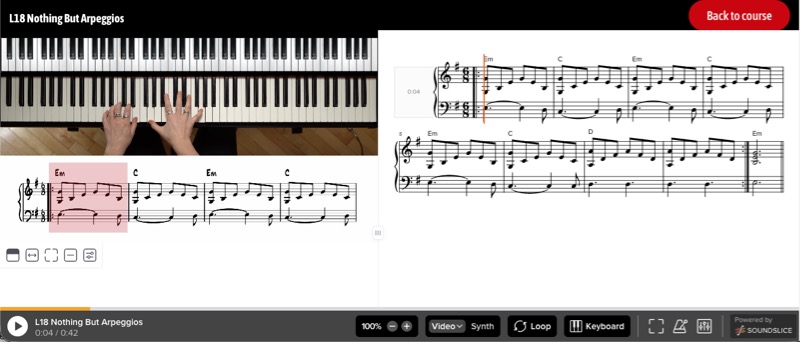
The lessons include interactive sheet music with an app called Soundslice. The notation is synced to a video of Marine playing the song with a camera overhead so you can see what she’s doing. When you’re playing along, you can slow down the tempo or loop specific sections. That has been transformative for me. You can even loop the song and automatically increase the tempo with each repetition 😮
Most excitingly, I finally got the hang of the sustain pedal through this course. When my piano arrived, I regarded the sustain pedal like a cat that had just spotted a cucumber: “I already have to play two different clefs with my hands and now you want me to operate a piggin’ pedal?” It lurked in a dusty corner for nearly two years, but now it’s been liberated. My partner thinks that learning bass has made the sustain pedal easier to manage. When you play bass, you spend quite a lot of time muting the other strings. The movement of playing then muting becomes instinctive after a while, and it’s similar to pressing and releasing the pedal.
I still enjoy playing simple Bach pieces for my own amusement, but for now I’m having a marvellous time playing Queen songs🤘
❤️ This post doesn’t include any affiliate links - I just want to promote an excellent course and its creator.