
One of the early obstacles in a research project is getting overwhelmed by the literature. Even if you’ve limited your scope, there’s still a lot of material to interrogate. It’s easy to fall into a trap of reading everything from cover to cover, making sure you haven’t missed anything. But if you want to finish before you’re 95, you need to read strategically. Without a clear strategy, you can disappear down a research rabbit hole. Although it’s fun hanging out with the bunnies, they won’t help you get your writing done.
A core part of the strategy is being selective. Not all sources are equally important, as this quote from Elizabethan philosopher Sir Francis Bacon illustrates:
“Some books are to be tasted, others to be swallowed, and some few to be chewed and digested; that is, some books are to be read only in parts; others to be read, but not curiously; and some few are to be read wholly, and with diligence and attention.”
I can’t remember where I originally saw this quote, but I do vividly remember its effect on me. Suddenly, I realised my existing strategy (if I could dignify it with that term) was self-defeating. There was no way I could read everything in detail. This was just a weaselly way of putting off writing. Now a reformed character, I came up with the Bacon Method for approaching my literature in a more sensible way.
🥓 The Bacon Method helps you decide how much of your time and attention the source deserves:
- Taste? – You’re seeking specific facts or widely accepted foundational concepts. For example, what’s the standard definition of a term you’re using? You find what you need, then move on.
- Swallow? – You’re seeking background details to provide context, but this research isn’t the focus. There’s no need to engage with it “curiously” or critically.
- Chew and digest? – You’re seeking a thorough understanding. For example, this source contains many of your keywords or directly addresses your research question. You might need to reread all or parts of this source several times “with diligence and attention”.
Visual planning tools like Trello are helpful for working out your strategy. You can use colour-coding to organise and rank your sources.
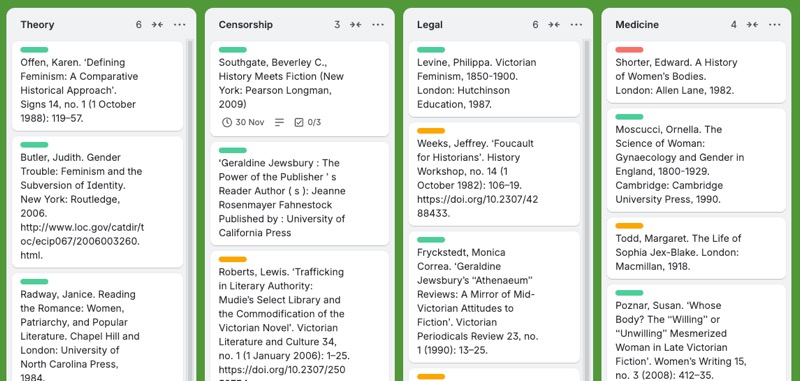
In Zotero, you could create a similar system with colour-coded tags.
You can also apply the Bacon Method to individual sources. In a book, for instance, you might need to chew and digest specific chapters, but just taste others. There might even be some sections you can skip altogether. This feels rude, but the author really won’t know.
There are some sources that shouldn’t be even touched, as they lie way beyond the scope of the current project. It’s tempting to think that researching future projects is efficient, but it’s impossible to achieve the necessary depth if we’re trying to answer multiple research questions simultaneously. The more we limit the scope, the faster the progress. And with the Bacon Method we can dodge those rabbit holes 🐇
The Bacon Method is part of my workshop on Planning and Structuring Your Literature Review.