September was an usually exciting month, as I actually left the country. I’m very much an indoor pet, so my partner has to do a lot of coaxing for me to go on holiday. We agreed on Amsterdam, a city we both love and one reachable from London by train in just 4 hours. Byway Travel, who specialise in journeys by rail and sea, handled all the bookings and found us an eco-conscious hotel a short tram ride from the station. Eurostar was very smooth, quiet, and comfortable. Unlike Thameslink, their designers actually have the human bottom in mind. Astonishingly, Thameslink delivered us to St Pancras with plenty of time to spare. We had a backup plan, though. You can buy a special Euro High Saver Return ticket at your local station that entitles you to travel on the next available Eurostar if your train is delayed.
In Amsterdam, we visited the Rijksmuseum, dodging people who were checking their email right in front of a Vermeer. I’m not quite old enough to bellow at them, but suspect that’s not far off. Although Rembrandt’s Night Watch is currently undergoing restoration, they’re doing it in public. That part of the gallery has been screened off with a glass wall so you can see the conservators going about their painstaking business.
We continued the Rembrandt odyssey by visiting his house on Jodenbreestraat, which is a museum and gallery space. Although much more a modern museum than a preserved house, some of the spaces are utterly magical, such as Rembrandt’s art room where you can see his collection of curiosities.
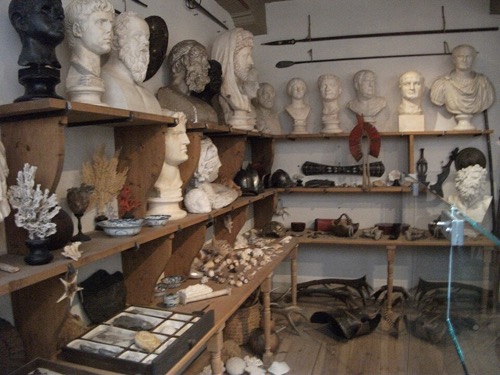
Johnbod, CC BY-SA 3.0, via Wikimedia Commons
Still very much mourning the loss of my cat, I was desperate to visit the KattenKabinet. This canal-side gallery is dedicated to artworks featuring cats. The collection includes paintings, drawings, sculptures by Picasso, Rembrandt, Toulouse-Lautrec, Corneille, Sal Meijer, Théophile Steinlen, Ed van der Elsken and Jože Ciuha. Even better, there are at least four resident cats. I was so busy talking to one on a chaise longue, I completely missed this incredible ceiling.
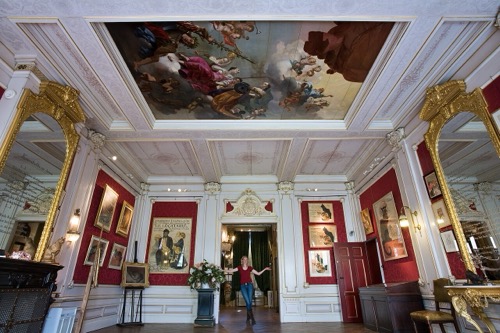
As all the furniture has already been downholstered by the mogs, you’re allowed to sit anywhere. It was such a restorative space.
Nearby, we found the Museum Willet-Holthuysen, an imposing townhouse on the Herengracht. In the 19th century, it was the home of art collectors Abraham Willet and Louisa Holthuysen, who entertained Amsterdam’s upper classes in their lavishly furnished salons. The money came from Louisa’s father, a successful glass and coal merchant. I wonder how many bags of coal it took to buy the Meissen chandelier?
Perhaps the best treat was a performance by Petar Pejčić and Nour Ayadi at the Concert Gebouw. Pejčić is an astonishingly good cellist who played a range of pieces by Prokofjev, Živković, Rostropovich, and Sjostakovitsj. Ayadi accompanied him on piano. For one piece, she actually plucked the piano strings - something I’ve never seen before. The duo were given two well-deserved standing ovations, for which we were rewarded with four more pieces. Pejčić was completely dazzling.
Due to a mishap on the final day, we also got the opportunity to try out the Dutch healthcare system. There was a wait of just 30 minutes to see a doctor. It was also free, thanks to the Global Health Insurance Card (GHIC). I’d assumed that was one of the many Brexit casualties, but it lives 🎉
Concerts 🎻
I didn’t manage many concerts this month, mostly because there seemed to be a lot of other stuff going on. But I did go and hear the Brighton Early Music Festival’s Polyphony Crawl, an annual event where they perform a selection of Renaissance and Baroque pieces at four local churches. The programme included works by John Dowland and Thomas Weelkes. This is a warm-up for their main festival, which starts on 2nd October.
Music 🎵
I was floundering for a while after finishing the Bass Buzz course and ended up mainly noodling. I’ve just started a new course that goes beyond the basics. I’ll share a review when I’ve finished. So far, it’s going well. I’m much nippier around the fretboard and am less frightened of tricky syncopation.
After throwing myself into rock and pop piano over the summer, I’ve now gone creeping back to classical music. I find it really hard to stick to a style. I just have to accept that my brain needs a lot of novelty and variety and this is a safe way of indulging it. I’ve been enjoying myself with some simple arrangements of Rameau and Telemann. Next week, no doubt, I’ll be back on Deep Purple 🤘
Cinema 🎬
I’ve somehow fallen out of the habit of going to the cinema lately. However, I was tempted out by Pulp: What Do You Do for an Encore? Directed by Garth Jennings, the film is a celebration of Pulp’s 2025 reunion tour, combining archival material with concert footage. It’s narrated by Jarvis Cocker, who also did a live Q&A after the screening. As you might expect, it’s quirky, funny, and warm. The absolute highlight for me was a clip of Jarvis appearing on Trevor and Simon’s Saturday morning show. He emerged through a tiny door on a pirate ship to find Frank Bruno contemplating a pair of bellows. There is no better illustration of the madness of children’s telly in the nineties.
Books 📚
There were many reading highlights this month. In Hagitude, Sharon Blackie encourages us to reimagine the second half of life, using folklore and archetypes. I never thought these ideas were in my wheelhouse, but I found the book incredibly invigorating. I also encountered the term “Apprentice Crone”, which might find its way to my LinkedIn profile.
Christian McEwen’s World Enough and Time is a beautiful meditation on the importance of slowing down and appreciating life. Again, this is something that wouldn’t have appealed to me a few years ago. Once you reach your 50s, there’s no choice but to be more selective. McEwen makes this feel like a wonderful opportunity, rather than a compromise.
I’m mainly craving non-fiction right now, but made at exception for Sarah Hall’s Helm. This ingenious novel is about a ferocious and mischievous wind called Helm, which presides over the Eden Valley. The narrative switches between the stories of those whose lives have been affected by Helm over the centuries, including a neolithic tribe, a wizard priest, and a Victorian engineer. In the present day, researcher Dr Selima Sutar realises that humans are fighting back and destroying themselves in the process. Although the message is sobering, the writing is effervescent and often very funny. Helm narrates a couple of chapters, commenting acerbically on the people below and expressing outrage at the invention of the hot air balloon.
While Rebecca Solnit’s A Paradise Built in Hell focuses on a series of disasters, including earthquakes, hurricanes, and terrorist attacks, it’s uplifting and life-affirming. Solnit shows how people cooperate to rebuild communities, even in the wake of unimaginable devastation. The problems typically occur when state bureaucrats intervene, enforcing property rights above welfare and establishing hierarchies. As Solnit points out, it’s easy for us to underestimate our willingness to help each other: survival-style TV shows are usually focussed around a ghastly Ayn Randian vision of us fighting over the last packet of noodles. You win by defeating everyone else, not by building connections. In real life, the opposite is true.
Work 👩🏻💻
My workshops kick off next month, so I’ve been updating some existing sessions and also creating a new one called The Neurodivergent Researcher. I’m also coaching again after a much-needed break.
Writing ✍️
I did quite a lot of writing in September, mainly for my new website The Livelihood. I’ve also been pinging out a few short tutorials here to support my forthcoming workshops. It’s so hard to point to resources that aren’t either AI slop or covered with distracting and inappropriate adverts. I’m creating more of my own content so I can make sure it’s accurate and up-to-date.
I attended a lot of online writing retreats, mainly through Shut Up and Write. These sessions have provided a lot of structure, accountability, and support. I’m also joining most of the magnificent Victorian Popular Fiction Association’s writing retreats. I can’t easily attend their conferences these days, so this is a welcome way to meet with other people who enjoy spending time in the nineteenth century. Frankly, it was a lot simpler then.
After tarting around with some other writing tools, I’m now going steady with Scrivener again. Hopefully, we’ll prove to be a good partnership in October.