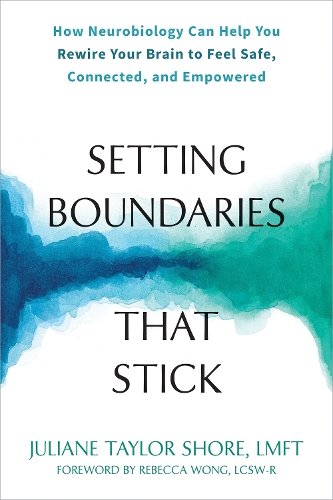
Boundaries are hard. We have to create them, protect them, and also respect other people’s. Haven’t we already got enough to do? In Setting Boundaries that Stick, clinician Juliane Taylor Shore offers a neurobiological approach to boundary work, based on the idea of the “integrated brain”:
In an integrated brain state, you can synthesize information from many different neural networks into a cohesive whole. When your brain is more integrated, you are more responsive than reactive and can have a nuanced view of things and access to creativity and resources for problem solving. When your brain senses that you and your body are physically and psychologically safe, it will take the time to connect and communicate with all of its parts, to integrate them.
Unintegrated brains are more reactive, resorting to binary thinking and moving quickly. While this mode is helpful when we’re under threat, it’s a liability in situations that require nuanced thinking. Boundaries provide the protection you need for your brain to slow down. With more space, you can consider your options, retrieve your inner resources, and ask questions.
Without this protection, it’s hard to think about our own needs. Our brain becomes accessible to others, rather than to ourselves. There are many situations where this makes us vulnerable. If we can’t activate our neural networks, it’s much easier to bounce us into decisions that serve other people’s interests. So many of the decisions we’re expected to make - even around jobs and homes - are supposed to happen instantly. This is a limited offer, there’s no time to lose!
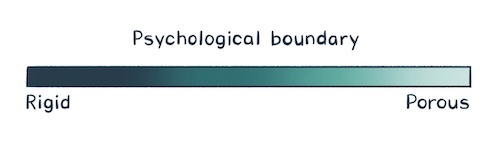
Taylor Shore describes a spectrum of how we interact with the people around us. At one end, we have porous or more flexible boundaries; at the other end, our boundaries are rigid or strict. Porous boundaries are appropriate in high-trust environments where we know others will respect our priorities, but often they arise from a lack of confidence or a need to be liked. We can encourage others to be more porous by creating spaces of genuine psychological safety. Rigid boundaries are essential where trust is low, or where we fear racism, homophobia, misogyny, or any of their ugly siblings. There’s no correct position on this spectrum. It’s about choosing a state that best fits the situation and being prepared to adapt it where appropriate.
I think technology lulls us into making our boundaries more porous. The faux chumminess of LLMs encourages us to lower our defences and share far more information than is sensible. Even worse, it cultivates rigid boundaries with other humans, who seem somehow less real than our eager-to-please chatbot. And those pesky humans also have their own boundaries that we’re supposed to respect. When our brains are unintegrated, our expectations become unreasonable. It’s OK for us to be rigid, but everyone else should be immediately porous and do whatever we want.
Increasingly, we’re encouraged to build walls rather than boundaries. Whereas walls keep people out, boundaries promote connection:
Boundaries help us to clearly communicate who we are, in alignment with our values. It may seem paradoxical, but boundaries help us to connect to others. Doing boundary work is an act of love for both self and other people.
But we’re often told that boundaries are selfish - especially if we’re a woman or from a marginalised group. Setting boundaries shows a lack of gratitude or signals that we have ideas above our station. Boundaries are sometimes portrayed as controlling, especially if a supposedly weaker person is saying no to someone who perceives themselves as stronger: “You can’t tell me what to do!” But, when you set a boundary with someone, “you are letting them know what you will do, not what you want them to do”. It’s the difference between “You have to stop yelling” and “If you keep yelling, I’m leaving the room”. The shouty person has a choice, and so do you.
As Taylor Shore acknowledges, “[a]sserting boundaries is easier or harder depending on what body you are in and who is around you”. I find asserting boundaries much easier now I’m older. Many people find menopausal women scary, and for good reason. We tolerate far less nonsense. Although I’m now naturally cantankerous, I’ve also had a lot of practice with saying no. This builds a neural network that forms part of the integrated brain. It takes time - maybe 2-3 years for a permanent change - but anything worthwhile takes time: “the more frequently you respond in a certain way, the more likely you will respond the same way in the future.” You can become better at saying no, or better at people-pleasing. Setting Boundaries that Stick offers dozens of scripts and exercises to help you start small and exercise those boundary muscles. The book is only 150 pages long, and you’ll find warmth and wisdom on every one of them.
Boundaries aren’t just for the workplace. I’ve found boundaries are an effective way of sifting friendships. If a friend is willing to work on boundaries, they’re a keeper. But if they constantly test those boundaries or refuse to recognise them in the first place, that’s no foundation for friendship. When two people take each other’s boundaries seriously, that relationship becomes a joyful place of strength and trust. I love this quote from Prentis Hemphill: “Boundaries are the distance at which I can love both you and me simultaneously.” If your boundary is someone else’s trigger, that’s useful information.