I’ve also shared the Pomodoro Technique in hundreds of workshops and coaching sessions. That’s given me the opportunity to find out how people are actually using it. As with any technique, you get purists who insist you must use it in a specific way. They want you to pay them money to explain that you’re doing it all wrong. There’s no wrong way to use the Pomodoro Technique. And there’s no right way, either. It’s whatever way is helpful for you.
In this post, I’ll explain the Pomodoro Technique for anyone who’s unfamiliar with it, then I’ll share seven potential adjustments that might make it better for you.
The Pomodoro Technique
The Pomodoro Technique was devised by Francesco Cirillo back in the 1980s. The science behind it is that most of us can focus for only 25 minutes before our mind starts to wander. That’s when we resort to faffing and stop making any actual progress. A 5-minute break allows our brain to relax, but it’s not long enough for us to lose momentum or forget what we were working on (unless you’re over the age of 45). For more on the science of distraction, take a look at Attention Span by Gloria Mark.
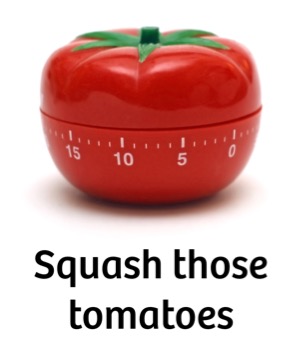
Pomodoro is Italian for tomato and it refers to those novelty tomato-shaped kitchen timers. Here’s what you do:
- Choose a task to be accomplished.
- Set your timer for 25 minutes. It doesn’t have to resemble a tomato.
- Work on your task without interruptions: don’t check email, make a cup of tea, or talk to the cat. If an unrelated thought pops into your head - which it will - quickly make a note of it and return to your task.
- When the buzzer or bell sounds, take a 5-minute break and record your progress.
- Repeat, taking a longer break for every 4 tomatoes.
That’s a simple summary. See the Pomodoro Technique website for the full framework and worksheets.
Making Your Tomatoes More Effective
1. Choose an appropriate activity
I’ve encountered several people who try to use the Pomodoro Technique for absolutely everything. While that might make you terrifyingly efficient, it can really suck all the fun out of enjoyable activities. The Technique is best suited to activities where you struggle to keep going. If you’ve quickly achieved a state of flow, a timer is going to be really annoying.
2. Use it only when necessary
Even with more challenging activities, you might not need to use the Pomodoro Technique for your entire session. Maybe one 25-minute tomato is enough to get you started. Your brain is likely to rebel against unnecessary structure.
3. Break down your task
From discussions with writers, the toughest part of the Pomodoro Technique is knowing what to work on. How do you break down your writing into smaller tomato-sized chunks? Well, the annoying answer is that it comes with practice. Once you start using the technique, you become adept at thinking, “Hmm, that looks like a two-tomato job”. Or, “I could knock that off in a tomato”. Depending on the type of writing you’re doing and how fast you write, you could assign a specific paragraph to a tomato. If you keep notes on your progress, you’ll get better at estimating how long everything takes.
Some tasks are difficult to break down, which is why 25 minutes might not be appropriate in all cases.
4. Set the right duration
If you’re pursuing the canonical Pomodoro Technique, then the duration is 25 minutes. In the early days, I never deviated from this length. Nowadays, that’s not enough time for me to get completely focussed and actually make much progress. I nearly always set the timer for 50 minutes, unless it’s an unbelievably tedious task, like proofreading. Generally, 50 minutes is long enough for me to immerse myself in the writing and build some momentum.
I’ve met many people who struggle to focus for 25 minutes, so need to work in 10- or 15-minute sessions. Conversely, others find that 50 minutes flies by, preferring 75-minute tomatoes.
It depends entirely on your preferences and the task you’re attempting. On a bad day, I might start with a 25-minute tomato to get warmed up, then move to 50-minute sessions. Getting an earlier break at the beginning makes it less daunting.
5. Take breaks
Breaks are an essential part of the Pomodoro Technique. I see so many people at writing retreats who ignore the timer and plunge straight into the next task. There are two big problems with this approach:
- Your brain will get tired, leading to mistakes and general grumpiness 😾
- You no longer trust yourself. You were promised a 5-minute break, but you didn’t get one 😡
As with the duration of the tomatoes themselves, you can adjust the length of the break. If, like me, your kitchen is a long way from your desk, you might need more than five minutes to get there, make a cup of tea, and come back.
I think it’s best to move around during the breaks. If you check email, succumb to social media, or catch up with some admin, there’s a risk that your brain will be completely consumed with somebody else’s priorities. Physical movement also helps avoid back problems and fatigue. On no account tackle a “5-minute job”. If you think, “Oh, I’ll quickly pay this bill” … three hours later, you’ll be pleading with an AI chatbot to recognise your existence and give you access to your own money. Fetch a drink, take a quick scamper outside, or practice your dance moves. If you do something completely different, it activates your Default Mode Network. When you return to your desk, you’ll probably find the solution to whatever had been confounding you earlier.
⚠️ A few years ago, a client made fantastic progress with the Pomodoro Technique. In every break, she went downstairs and rewarded herself with a biscuit. Although she submitted her thesis early, she gained nearly 30lbs in the process.
6. Improve your focus
Of course, it’s very easy to set a timer. Apart from wearing velcro pants, how do you stay in the chair and actually do some writing? Many of us can’t be trusted to write unsupervised, so platforms like Focusmate are an absolute boon. Here you can book a 25-, 50- or 75-minute writing session with a buddy. I used Focusmate for writing two of my books, with two 50-minute sessions every weekday morning for around six months. That was enough time to produce a Shitty First Draft. Communities like the London Writers’ Salon offer 50-minute hosted sessions.
I’ve tried various apps and platforms that bundle Pomodoro timers with focus-enhancing backing tracks. They often start well, then become unnecessarily complicated with annoying and expensive AI features. I tried one platform where you were supposed to chat with other people during the tomato breaks 🙀
My preferred approach is Toggl Timer and MyNoise. This gives me complete control over the duration and background sounds. And I don’t have to talk to random strangers. This combination is my imaginary Writing Fortress.
7. Experiment with your own approach
🤔 Once you’ve tried the Pomodoro Technique, reflect on these questions:
- Did you get fidgety before the 25 minutes had elapsed? If so, perhaps you need a shorter session, or to build up to 25 minutes.
- Was it frustrating to stop after 25 minutes? Either a longer session might be better, or maybe you don’t need the Pomodoro Technique at this stage. You can always deploy it another time when it’s harder.
- Did you have trouble regaining focus after the 5-minute break? Were you getting engrossed in something online? If so, try a physical activity that doesn’t require too much cognitive effort.
- On average, how much did you achieve during a tomato? Once you understand your process, it becomes easier to decide how many sessions you’ll need over a week. It’s helpful to consider the type of writing, too. For example, “I can produce 300 descriptive words or 100 analytical words.”
Conclusion
It takes some time to find an approach that suits you. Once you’ve cracked it, though, the Pomodoro Technique can boost your writing productivity. I find that two 50-minute sessions are far more effective than a whole day of writing without a timer. To reiterate, it’s not about following a specific methodology or trying to apply what works for someone else. You’re a writer, not a machine. Allow yourself to experiment, and take it one tomato at a time 🍅