If you’ve read How to Write a Narrative CV, you’ve seen the step-by-step process for drafting individual examples using OCAR. In this post, we’ll explore a more complex aspect: how OCAR works at three nested levels within your narrative CV, and how to avoid common pitfalls when using this structure.
As I mentioned in an earlier post, the OCAR framework (Opening, Challenge, Action, Resolution) is effective in most types of academic writing. It’s also helpful for developing an narrative CV. This storytelling approach:
- Creates coherence: the OCAR structure transforms disconnected achievements into a coherent narrative.
- Emphasises problem-solving: by describing challenges and their resolution, you showcase your innovative thinking.
- Demonstrates impact: the Resolution component naturally focuses attention on outcomes rather than just activities.
- Shows progression: OCAR naturally creates a sense of development and growth in your research journey.
- Makes contributions memorable: Reviewers are more likely to remember your achievements when presented as stories rather than lists.
Your Three Stories
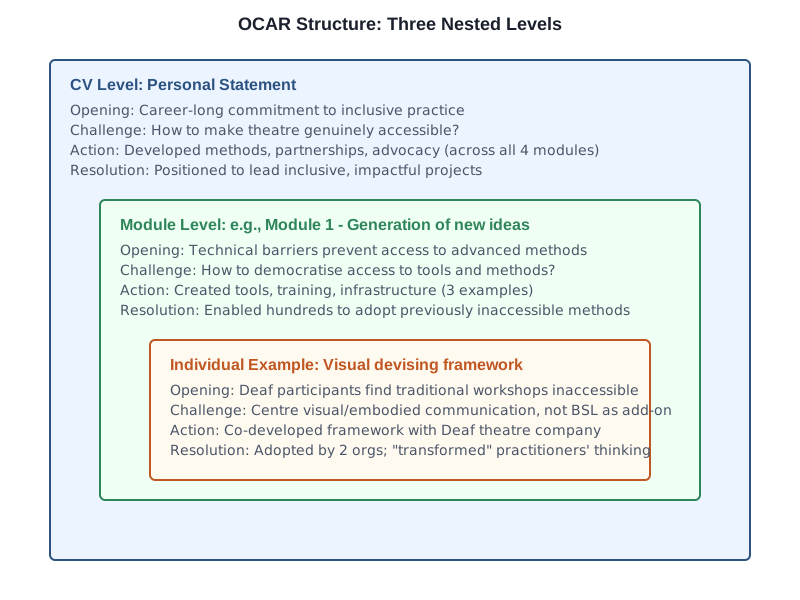
In your narrative CV, OCAR works at three distinct levels:
- Individual example level: The story of each specific contribution.
- Module level: The story that connects multiple examples within each of the four modules.
- CV level: The overarching story that spans all four modules (your Personal Statement)
That overarching story becomes your personal statement: the story of you as a researcher.
Each level uses the same OCAR structure, but at different scales. Think of it like zooming in and out on a map — the same landscape, but different levels of detail.
Building from the Bottom Up
Start with individual examples
It’s much easier to write about a specific achievement than to think about your entire career at once.
For the complete step-by-step process of drafting individual examples, see How to Write a Narrative CV. That post covers choosing achievements, identifying OCAR elements, drafting, and refining for concision.
Once you have 2-3 examples drafted for each module, you’re ready for the next level…
Identify your module-level narrative
Once you have several examples drafted within a module, step back and look for patterns:
- What themes connect these examples?
- What broader challenge were you addressing across multiple projects?
- What collective impact did these contributions achieve?
Your module-level OCAR shouldn’t simply repeat what’s in individual examples. Instead, it shows how they work together:
- Thematic linking: “These three contributions demonstrate my sustained focus on accessibility…”
- Progressive development: “From initial tool development, through training materials, to infrastructure…”
- Complementary approaches: “I’ve addressed barriers from multiple angles: technical, educational, and structural…”
Create Your Personal Statement
Your Personal Statement (2-3 sentences) is the most condensed OCAR, distilling your entire career narrative. It should emerge naturally from your module-level narratives, not the other way around.
First draft the full OCAR version (3-4 paragraphs), then distil it ruthlessly to its essence. For more guidance on this process, see Writing Your Personal Statement.
Common Pitfalls with Narrative CVs
Repeating the same information at each level
Each OCAR level should add different value:
- Individual: Specific details of this contribution.
- Module: How examples connect thematically.
- CV: Your overarching researcher identity.
Avoid simply restating the same achievement at three different lengths.
Getting the proportions wrong
Within each OCAR narrative, aim for roughly:
- Opening: 20%
- Challenge: 15%
- Action: 40%
- Resolution: 25%
💡 Many researchers spend too long on context (Opening) and downplay the impact (Resolution).
Vague Challenges
“I wanted to improve things” is too general at any level. Compare:
- ❌ Vague: “I wanted to make research more accessible”
- ✅ Specific: “How could we enable researchers without programming expertise to apply machine learning methods to their own data?”
Resolution that doesn’t connect to Opening
Your Resolution should circle back to the problem you identified in the Opening, showing how you’ve addressed it. This creates narrative closure and demonstrates impact.
See OCAR in Action
The best way to understand how OCAR works at multiple levels is to see it in practice. I’ve created two fully annotated narrative CVs showing the OCAR structure at all three levels:
- Annotated Example 1: Applied Theatre Researcher - Early-mid career, community engagement focus.
- Annotated Example 2: Health/Methods Researcher - Established career, methodological innovation focus.
Each example includes collapsible annotations showing exactly where each OCAR element appears at the Personal Statement, module, and individual example levels.
The Multi-Level Refinement Process
Creating these nested narratives requires working at all three levels simultaneously:
- Draft individual examples using OCAR (see the step-by-step method).
- Look for patterns to identify module-level narratives.
- Refine individual examples to strengthen the module narrative.
- Identify your overarching theme across modules.
- Draft your Personal Statement.
- Adjust module and individual narratives to reinforce the overall story.
This back-and-forth between levels is what makes narrative CVs challenging — but also powerful. You’re not just writing four separate modules; you’re creating a cohesive story that works at three scales simultaneously.
Next Steps
- Review the annotated narrative CV example to see nested OCAR in practice.
- Consult Writing Your Personal Statement for guidance on the CV-level OCAR.
- Read Strengthening Your Narrative CV Language for step-by-step guidance on editing your narratives.
The nested OCAR structure might feel complex at first, but it creates a powerful, coherent narrative that helps funders understand not just what you’ve done, but who you are as a researcher and why you’re the right person for their funding.