Even well-planned projects commonly experience a dip in momentum somewhere in the middle. This isn’t a sign that something has gone wrong, it’s a predictable feature of how many of us manage extended goals.
Clark Hull’s research on the goal gradient effect1 shows that people tend to move quickly at the start of a project, when energy and novelty are high, and again near the end, when they can sense the finish line. In between the excitement of the start and the relief of completion lies the plateau. Even processes that are working well lose their power over time.
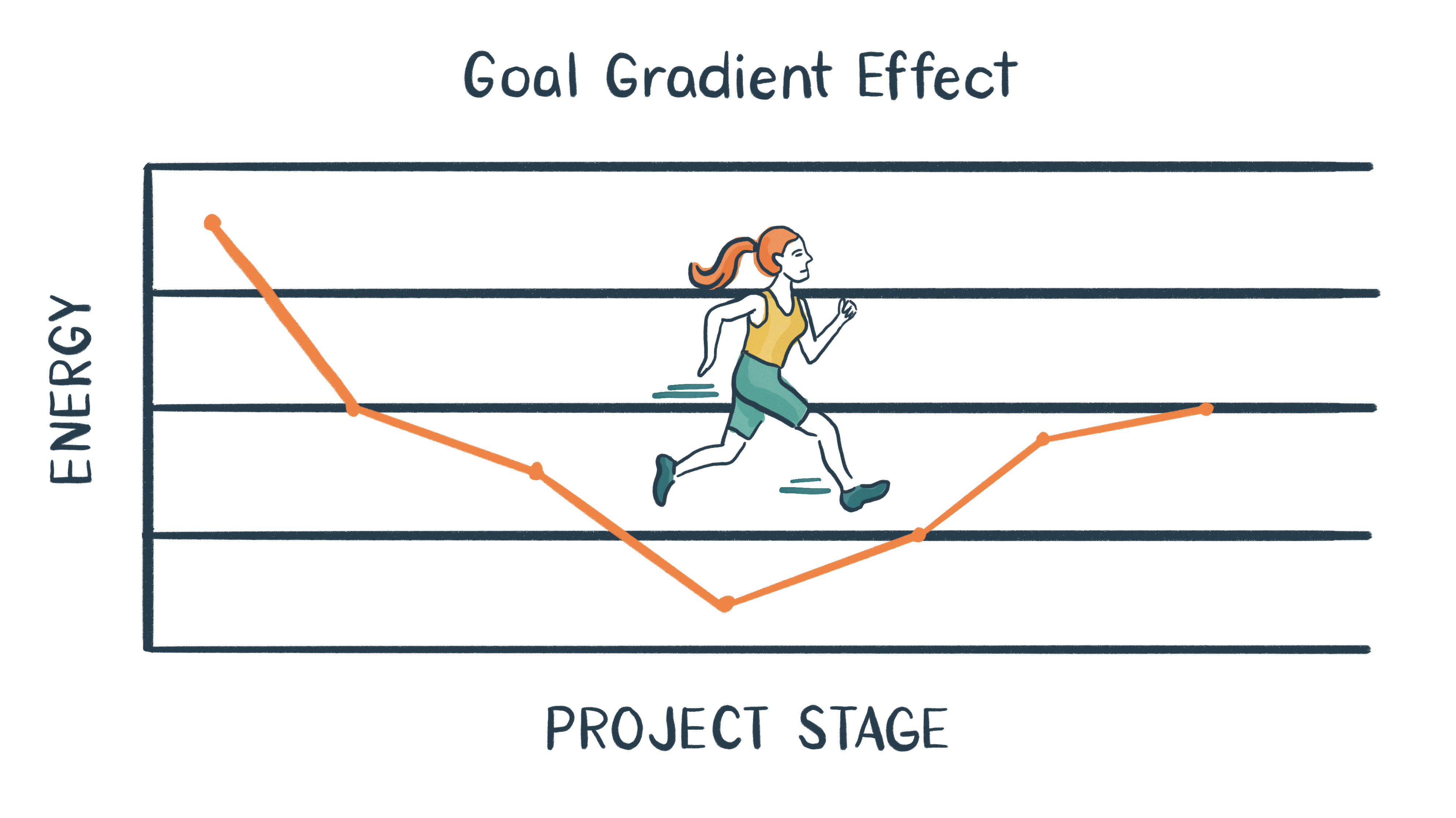
Here are two ways of addressing the sagging middle:
- Recognise its existence. That way, you aren’t caught out by it. You’re poised to inject some energy when it’s most needed.
- Eliminate the middle, or at least make it feel shorter.
Eliminating or shrinking the middle is called “narrow bracketing”. Rather than experiencing your project as a single long event, you break it down into a series of smaller projects, each with it’s own start, finish, and goal. These smaller projects have their own goal gradient, but the finish line is much closer.
Sprint-based working is a practical way to apply narrow bracketing. A sprint is a defined period of focused work with a specific, bounded goal. Rather than just tracking your progress against a project timeline that stretches months or years into the future, you are working towards something that’s achievable within weeks. The end of each sprint becomes a milestone: a moment of completion that resets momentum for the next phase.
A six-week sprint works well for smaller, more defined chunks of work, especially if you’re approaching a deadline. It’s also good for maintaining motivation when you’re struggling to keep going. A twelve-week sprint suits larger components, earlier-stage work where you’re still testing assumptions, or people who can sustain focus over longer periods. Whatever duration you choose:
- Decide on an achievable goal for that sprint, for example, the first draft of a paper or chapter.
- Break that goal into a smaller goal for each week of the sprint, for example, organising the data, creating the figures, describing the methodology.
- Break each weekly goal into specific tasks that can be completed in a day.
By staying on track with those daily goals, you’ll meet your weekly and sprint goals.
Sprints also create natural review points. At the end of each sprint, you assess what you achieved, revisit your risks and assumptions, and adjust your plan for the next phase. You’re embedding learning throughout the project, rather than right at the end.
Sprints aren’t necessarily suitable for all tasks. For the research process — conducting experiments, gathering data, completing analysis — checkpoint-based planning often makes more sense. Here, the checkpoint or milestone drives the duration. You keep going until you have completed that task or activity. Stopping arbitrarily mid-experiment or mid-analysis doesn’t make sense. The work has its own logic, and constraining it to a fixed duration can undermine its quality.
For activities such as writing, a sprint-based approach works better. Here, the duration drives the scope. You set a fixed period — say, six weeks — define what you’ll achieve within that time, and adjust your scope to fit if needed. The fixed duration creates the constraint that keeps your writing manageable and your momentum going. Without it, writing expands to fill whatever time is available. If you have strong nerves, take a look at this writing sprint, in which seven academics had just four days to co-author a book.
With sprinting - and writing generally - the trick is to keep moving 🏃🏽♂️
This resource is part of my workshop on Project Managing Your Research. If you’re struggling to keep going with a thesis, take a look at my book on How to Finish Your PhD.
See Anatomy of a Breakthrough by Adam Alter ↩︎